
 2 hours ago
4
2 hours ago
4
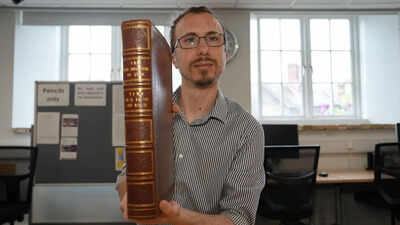
A worn volume bound in faded red leather has been formally recognised by the United Nations Educational, Scientific and Cultural Organisation as one of England’s earliest surviving paper-based archives.
It is the kind of object most visitors would walk past without realising they are looking at something that predates printing presses, predates modern record keeping, and still somehow survives the damp, accidents, and administrative neglect that erase so much of the medieval world. In King's Lynn, the book is known simply as the Red Register, and its pages carry the administrative memory of a town that was already busy, connected, and commercially alert in the 14th century, as reported by The BBC.The recognition has drawn fresh attention to a place that often sits outside the usual historical spotlight. What survives inside the register is not a romantic narrative of kings and battles, but something more grounded: the bureaucratic pulse of daily life.
What the Red Register reveals about life in crisis-stricken England
The Red Register, held in King's Lynn, is not a chronicle in the traditional sense. It is closer to a running log of civic activity, written in abbreviated Latin that would have been familiar to clerks but is far less accessible now.
Its entries move between wills drawn up during plague years, lists of men dispatched for military service during the Hundred Years’ War, and records of local freemen whose status defined their place in the borough.The texture of it matters. This is not a curated historical narrative written with hindsight. It is administrative work, recorded as events unfolded. According to The BBC, some pages carry the quiet disruption of the Black Death, where inheritance documents appear more frequently than trade records, suggesting how abruptly normal civic life was interrupted.For historians, that continuity is what makes it unusual. Many medieval records survive only in fragments or later copies. Here, a single volume holds overlapping responsibilities: legal memory, taxation reference, and civic identity rolled into one.
The surprising material choice behind the Red Register’s survival
Reportedly, one detail that tends to surprise even specialists is the material itself. In the 1300s, parchment was still widely used across England for official documentation.
Yet the Red Register was produced on paper, a material that was only just beginning to circulate through European administrative systems at scale.At the time, King's Lynn appears to have purchased around 200 sheets, a decision that hints at a willingness to adopt newer, cheaper materials for record keeping. Paper was less durable than parchment, particularly in damp conditions, but it allowed for faster and more flexible administration.
The survival of the register, despite water damage along some edges, feels almost accidental in that context.
What survives from the Black Death and wartime years
Some of the most studied sections relate to periods of crisis. Entries connected to the Black Death do not describe the pandemic itself, but the administrative consequences that followed. Wills appear in clusters, reflecting sudden shifts in inheritance patterns. Property transfers and civic adjustments replace what would normally be routine economic records.Elsewhere in the book are references to men sent from the borough to serve in overseas campaigns during the Hundred Years’ War. These are not heroic accounts. They are lists, names recorded for obligation and accountability rather than commemoration.
What UNESCO recognition means for the Red Register’s survival
The inclusion of the Red Register in the Memory of the World programme run by UNESCO places it alongside some of the most widely recognised historical documents in Europe.
That list includes materials such as the Magna Carta and the Domesday Book, both of which are often treated as cornerstones of English documentary history.For archivists, the recognition is less about prestige and more about visibility. Small municipal records rarely attract attention outside academic circles, even when they preserve details that larger national archives miss. In this case, the register is not just a relic of medieval administration but evidence of how local governance operated in a period when written record-keeping was still evolving.
The town behind the book and its layered history
The register is tied closely to King's Lynn, a port town in Norfolk with a trading history that stretches back well before the medieval period. Known historically as Bishop’s Lynn, it was once a significant commercial hub linked to continental trade routes.Today, remnants of that past sit alongside modern civic life. The town’s historic buildings and archives continue to surface new material, sometimes in unexpected ways. Renovation work at St George’s Guildhall, which is widely regarded as one of the oldest working theatres in the country, has previously revealed timber structures dating back to the 15th century.That building, along with the register, forms part of a wider historical landscape that rarely makes national headlines but carries continuous documentary depth.








 English (US) ·