
 1 hour ago
1
1 hour ago
1
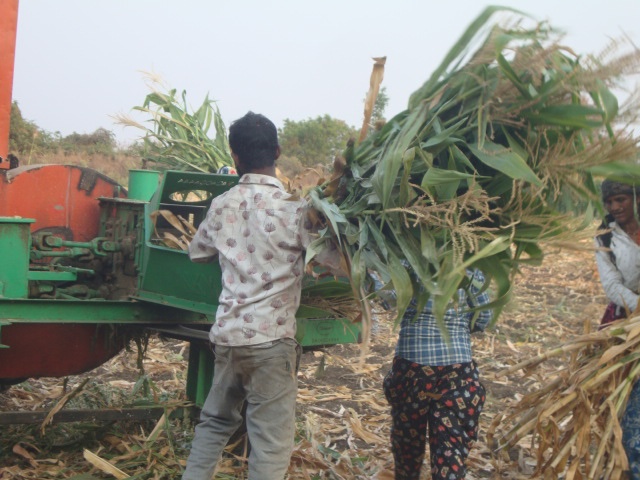 Chaff being loaded for cutting in a machine for fodder. Credit: Supplied
PUNE, India, June 10 (IPS) - Dharashiv is one of the poorest districts in the western Indian state of Maharashtra. Located in the semi-arid region of Marathwada, it has no major river and is not blessed with good reservoirs.
The soil quality is poor and unable to retain water, even during heavy rainfall. Farmers depend on borewells and wells. Farm ponds go dry beyond February, leaving farmers bereft. The groundwater level is always low for most of the year. Generally rural, with agriculture as its mainstay, Dharashiv is mostly made up of landholdings averaging 4-5 acres. Rural unemployment is high, and large numbers of able-bodied men and women migrate to towns during the lean seasons.
But the last two years have seen a ‘Tool Bank’ initiated by a social and educational organisation – Jnana Prabodhini – in Harali village gradually reversing the tide.
The Indian government first mooted the idea of an implement or tool bank some years ago. A couple of state governments also initiated it.
However, it did not catch on, owing to many reasons. To understand the need and importance of a tool bank, it is imperative to understand the general scenario in the Dharashiv district, particularly in the Lohara block, which houses Harali village.
Scenario in Lohara block
Harali village in the Lohara block of Dharashiv district is located around 70km from both Sholapur and Latur towns and is close to the Karnataka-Maharashtra border.
There are no big rivers in the vicinity; the only sources of water are rivulets like Benitura, which is a tributary of the mighty Godavari River, which flows several kilometres away.
The literacy level is quite low, and the population comprises some nomadic tribes as well.
The local population, most of whom depend on agriculture, faces difficult living conditions due to a lack of good schools and colleges, inadequate water, poor soil quality, and a fluctuating electricity supply.
Even otherwise, the entire Lohara block, comprising 25 villages, is semi-arid and drought-prone. The average rainfall is around 735 mm. However, with climate change, the last few years have seen it receive (as high as 147 percent) above-normal monsoon rains and high pre-monsoon rains, causing floods and crop losses for farmers.
It was following the Latur earthquake in the ‘90s that Jnana Prabodhini, a Pune-based organisation, moved to Harali for relief and rehabilitation work.
Keen to make a difference, Jnana Prabodhini set up a school here. In 1996, the school moved into permanent premises. Soon after, a nursery section was added, and by the 2000s, an agricultural college – the Krishi Tantra Vidyalaya and its demonstration farm – was established on the premises. To facilitate hands-on learning for students, several farming implements had to be purchased. And thus, the idea of starting a Tool Bank for local farmers came up.
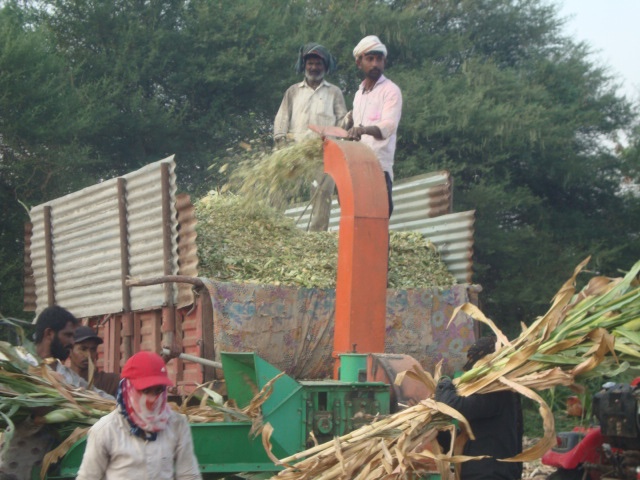 Chaff cutter at work on a farm. Credit: Supplied
“Rural unemployment is a huge concern here. We, hence, thought of training our students, who are local youth, in the handling of implements. We also popularised the course among farmers. We now have a tool operators group. Youngsters now hire the tools and work for the farmers during the sowing and harvesting season, earning a steady income in the process,” says Jnana Prabodhini Harali (youth cell) Coordinator and Tool Bank head Suresh Margale.
Take the case of Maruti Badgir, who is currently studying for his higher secondary-level exams at a local college.
Badgir completed a diploma in operations and basic maintenance of farm implements at the Krishi Tantra Vidyalaya. He now rents tools from the implement bank and works for farmers in the area during the planting and harvesting seasons.
Farm labour shortages are common in the region, and an operator from the nearby town charges Rs 5500 (about USD 59) to operate a harvester.
A local youth trained to operate the machine, on the other hand, charges only Rs 3000 (USD 32). Similarly, charges for a Chaff Cutter or any machine from town are as high as Rs 1200 (USD 13) per hour, while local charges are only Rs 150 (USD 1.61) per hour. The Tool Bank charges Rs 20 (USD 0.22) per hour as rental and, hence, Rs 60 (USD 0.65) for three hours. Some farmers who own tractors and have undergone training, such as Iqbal Sheikh, hire implements from the Tool Bank and render their services, supplementing their income.
After paying the rental and fuel costs, an operator can earn Rs 800-2000 (USD 8 to 22) per day during the peak farming season, since a minimum of Rs 800 (USD 8.61) is earned for 8 hours of work. “During the kharif and rabi sowing and harvesting seasons, these operators can make a neat Rs 30,000 to 40,000 (about USD 322 to 430) a month, given the labour shortage and the demand for their services,” Jnana Prabodhini Harali Centre in-charge Abhijit Kapre says.
Farmers like Kondiba Pandhre and Shankar Deokar directly borrow and use the implements on their farms, since they have undergone training.
“It saves us a lot of money,” Pandhre and Deokar tell me. It has also helped them expand their farming operations. Deokar, who owns nine acres of land and a tractor, seeder, rotavator, and other equipment, now hires Broad Bed Furrow (BBF) machines, power tillers, cutters, trolleys, and furrowing attachments.
“Farm labour is hard to find nowadays. With these machines, I save a lot on labour charges as well as time. I only need to hire one labourer to operate a manual seeder now,” he says. Deokar’s lush farm grows a wide variety of vegetables besides millets, soybeans, onions and black gram. He has also put up a biogas plant which runs on farm waste. Pandhre, who owns six acres of land and was earlier cultivating urad (black gram), mung (green gram), soyabean, onion, and carrots, has planted 1600 moringa (drumstick) trees on two acres of his land this year. Since Moringa has commercial value, Pandhre hopes to earn handsomely from his initiative.
Farmers are particularly fond of the BBF machine, which makes raised beds that are 90-150 cm long, with furrows that are 45 cm wide and 30 cm deep. Operating as a seed-cum-fertiliser planter, it brings enhanced aeration and better root development and can help in soil and water conservation in rainfed zones that suffer from irregular rainfall, moisture stress, and waterlogging. Farmers who cultivate sugarcane can avail themselves of Harvesters and Power Tillers too, which are particularly useful for the crop.
The other advantage is the saving of seeds. Deokar especially cites the case of soyabean. “Earlier, I needed 30 kg of soyabean seeds for planting and got eight quintals per acre. Now, I need only 25 kg of soybean seeds, and I can ensure yields of 10 quintals per acre. Furthermore, deep furrowing removes pests and helps us save on pesticides, too.”
Besides rentals being lower than in adjoining cities and towns, availability is guaranteed. “During the harvest and sowing seasons, even if we travelled to adjoining Sholapur, Umargaon, or Latur, availability was never guaranteed,” Vaijnath Kashinath Gavare of Sayyad Hipparga village tells me.
And buying was hardly an option for most farmers, with most implements ranging around Rs 2 lakhs and Rs 4 lakhs (USD 2400 to USD 4800)
A BBF machine also helps ensure that a natural disaster does not ruin a farmer.
Farmer Somnath Vinayak Bairajdar, who owns a 12-acre farm in Sayyad Hipparga village in Lohara block of the district, tells me, “Beds made by a BBF machine ensure that water is held by the soil in dry weather, while during untimely and very heavy rain, water easily flows out. The last two years saw this region experience heavy rainfall and flooding.
Many farmers lost all their crops. But my crops survived.”
A power tiller can help lighten the soil and aerate the roots, while a weeder removes pests, ensuring a better yield, Bairajdar says. “Earlier, I could have 5 to 6 tonnes of tomatoes per acre. But now, it is as high as 8 to 9 tonnes per acre.”
His pigeon pea yield has also climbed up from 6 to 7 quintals per acre to 9 quintals per acre, while green beans have risen from 2 quintals per acre to 4.2 quintals per acre, “thanks to my use of the power tiller”.
Certain tools can also help farmers supplement their income.
Sharad Patil, for instance, who owns a 25-acre farm, has been able to expand his dairy business. “Earlier, I could only keep four cows, since I only owned a manual cutter to prepare the fodder for my animals. Now, I hire a chaff cutter, which is attached to my tractor, to do the job.”
Patil now has 34 cows in his shed; hiring a Chaff Cutter for three to four days provides him enough fodder to feed his cattle for six months.
Another popular item at the Tool Bank is the electrical armature machine, given the erratic electricity supply in Dharashiv. “Farmers need uninterrupted electricity for their pumps, especially in summer,” Margale tells me. “The government had started a scheme for solar-powered pumps. But it is currently not in operation.”
In the two years of its existence, the Tool Bank has seen rising popularity, especially among farmers in villages in and around the taluka and beyond.
“We are planning to set up a couple of more depots in adjoining villages,” Margale tells me.
Meanwhile, inspired by the progress and well-being of their peers, farmers like Pandurang Haren and Ballu Hakke are keen to start hiring tools from the Tool Bank and enrolling in a skill training programme.
The Tool Bank is breeding hope and positivity in Dharashiv while helping farmers fight the worst effects of climate change.
IPS UN Bureau Report
© Inter Press Service (20260610075832) — All Rights Reserved. Original source: Inter Press Service








 English (US) ·