
 1 hour ago
4
1 hour ago
4
Abu-Bilal al-Minuki was eliminated in a joint operation by the US and Nigerian forces, the president has said
US President Donald Trump has announced that Abu-Bilal al-Minuki, second in command of Islamic State (IS, formerly ISIS/ISIL) worldwide, has been killed in Nigeria on his orders.
The operation comes as Washington seeks to reassert its influence in Africa’s volatile Sahel region where a string of military coups and growing anti-Western sentiment have weakened the positions of the US and its European allies.
Al-Minuki was eliminated overnight as a result of “a meticulously planned and very complex” joint mission by American and Nigerian forces, Trump wrote in a post on his Truth Social platform on Saturday.
The US president said that the senior IS commander, whom he described as “the most active terrorist in the world… thought he could hide in Africa, but little did he know we had sources who kept us informed on what he was doing.”
“He will no longer terrorize the people of Africa, or help plan operations to target Americans. With his removal, ISIS’s global operation is greatly diminished,” he wrote.
Nigerian President Bola Ahmed Tinubu said in a post on X that al-Minuki was killed together with several of his lieutenants in a strike at an Islamic State compound in the Lake Chad Basin.
US Africa Command (AFRICOM) later released aerial footage of the bombardment.
Last night's operation targeted a significant presence of ISIS fighters in Northeastern Nigeria eliminating multiple high value individuals including Abu-Bilal al-Minuki. pic.twitter.com/lNj4AMSITH
— U.S. Africa Command (AFRICOM) (@USAfricaCommand) May 16, 2026Washington labeled Al-Minuki, who is a Nigerian national, a “specially designated global terrorist” in 2023 under the administration of then President Joe Biden. The State Department said that he was part of an administrative body within IS that provides “operational guidance and funding around the world.”
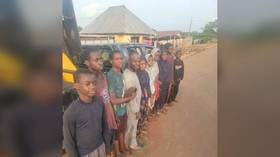
In December, Trump accused the Nigerian authorities of failing to protect Christians in the north-west of the country from Islamist militants. The government denied discriminating against any religious groups.
Shortly after that, the US carried out airstrikes targeting Islamic State-linked militants in Nigeria. It was followed by Washington sending 200 American troops to provide training and intelligence to the Nigerian forces fighting the jihadists. The US servicemen remained in a strictly non-combat role, according to the authorities.
In 2019, during Trump’s first term, he announced the killing of Islamic State founder and leader Abu Bakr al-Baghdadi in a US special forces raid in Syria.
Despite decades of American counterterrorism operations, jihadist violence continues to spread across parts of the Middle East and West Africa, with militant groups capitalizing on weak governance, poverty, and political instability.






 English (US) ·