
For many Parisians, the experience has begun to take on a bruising familiarity. Standing at the foot of a towering block of flats, circling higher and higher up a cramped stairway, squeezing out of a narrow lift, they find themselves time and again staring down a dozen or more Parisians just like them. They lock eyes, briefly, and look away.
Some are students, or workers, or white-collar couples leaning against one another at the end of a long week. Others have their children with them, peering down between the bars of the stairwell or curled against their parents’ chest. Family or friends, French or foreign, they wait, uneasy, until the apartment door opens, and the visits begin.
While finding an apartment to rent in a global city like Paris has never been simple, a feeling of genuine crisis has settled over the capital in recent years. Despite almost 180,000 residents leaving Paris over the past decade – an exodus that many researchers link to the rising cost of housing in the capital as well as the shock of the pandemic – the number of affordable homes to rent continues to fall short of the number of people searching for a roof over their head.
As Parisians prepare to vote for the city's new mayor in this Sunday's municipal elections, affordable housing has become a central theme in many candidates' bid for the Hôtel de Ville – though one that exposes sharp divisions on how best to address the crisis.
France's housing crisis: Who can afford to live in Paris?
To display this content from YouTube, you must enable advertisement tracking and audience measurement.
One of your browser extensions seems to be blocking the video player from loading. To watch this content, you may need to disable it on this site.
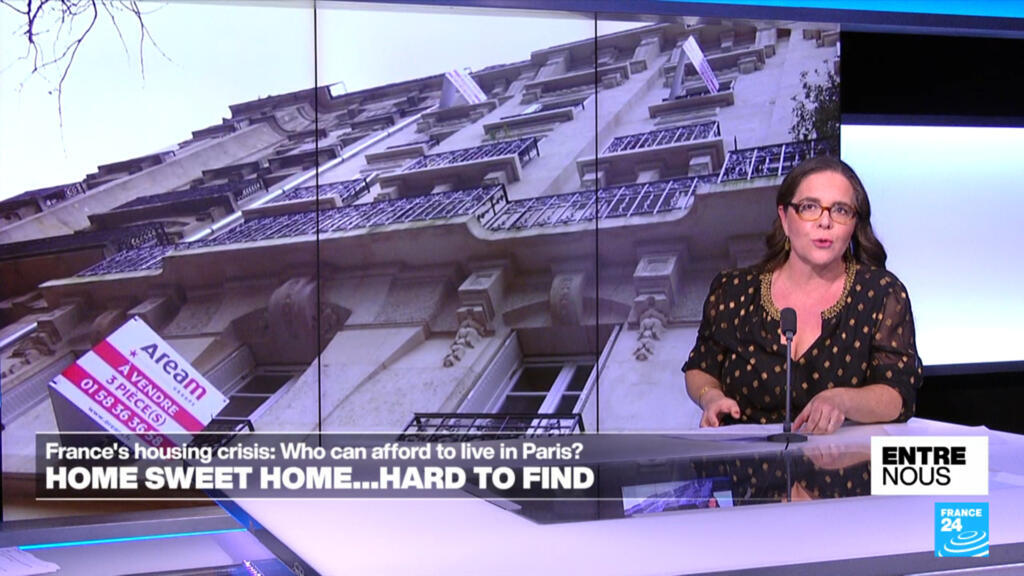 ENTRE NOUS © FRANCE 24
06:42
Claire Lévy-Vroelant, a sociologist and emeritus professor at the University of Paris VIII, said that Paris’s status as the world’s most attractive city made it a favourite among both tourists and real estate investors.
“Everyone is familiar with the term ‘gentrification’ – often preferred to its equivalent, ‘embourgeoisement’ – because it corresponds to a cruel reality,” she said. “The eviction of the working and middle classes from Paris due to the high cost of housing, both to rent and to buy.”
Short-term thinking
Although the number of housing units has increased by almost 200,000 since the mid-20th century, the number of homes that Parisians actually live in year-round has fallen. Instead, more and more units have been bought up as secondary residences, or else refurbished as short-term rental accommodation targeting the millions of tourists that pour into Paris every year.
The Atelier Parisien d’Urbanisme (APUR) estimates that as many as one in five homes in the capital were unoccupied for part of the year or longer as of 2020 – some 262,000 housing units.
Of this eye-watering figure, more than half are believed to be secondary or occasional residences – including apartments and other units mainly rented out short-term to tourists on sites such as Airbnb. Some 18,600 had been vacant for more than two years.
Jeanne Richon, a PhD student at Paris-Est Créteil University who has studied the rise of short-term tourism rentals in France, said that the potential profits have been very attractive for landlords.
“Since 2015, the number of short-term furnished rentals has exploded,” she said. “And this is linked to the fact that many owners are deciding not to rent their properties on the long-term market to residents, but to convert them into short-term rentals, even though this is currently prohibited in Paris – unless they have gone through a rather costly procedure to obtain a legal short-term furnished rental permit.”
And while Paris has since capped the number of days that a primary residence can be rented out on Airbnb or similar platforms at 90 days a year, it’s been hard to enforce. Of the 90,000 or so Airbnb rentals in the capital – more than 8 percent of the city’s total housing – some 25,000 are believed to be rented out illegally.
Divided left battles rising far right as France heads to the polls
To display this content from YouTube, you must enable advertisement tracking and audience measurement.
One of your browser extensions seems to be blocking the video player from loading. To watch this content, you may need to disable it on this site.
 "On the left, the presidential battle already on everyone's mind", says Le Monde © France 24
04:56
Competition over the rentals that remain is cutthroat. Real estate site De particulier à particulier reported in late 2024 that each listing of a studio or one-bedroom apartment received an average of almost 600 applications from would-be renters.
Buying a home in Paris sits well beyond most residents’ means – in 2024, real estate prices in the capital sat around €10,000 a square metre. For many of those whose work, school or family ties them to Paris, the only option is to rent.
Even that seems increasingly out of people’s reach. The average monthly rent has almost doubled in Paris since the turn of the 21st century, rising from just over €15 a square metre to more than €27 for the same space.
Rent controls put in place in 2019 by outgoing Socialist Mayor Anne Hidalgo have slowed the rise, but enforcement has been patchy – an annual report by the Fondation pour le logement des défavorisés published last September found that just under a third of rentals across the capital were not respecting the regulation.
“You only need to look at rental listing sites to realise that there are a lot of small properties that are rented well above the rent control limits,” Richon said.
Competing visions
So it’s little surprise that housing has become one of the main battlegrounds in the fight for the future mayor of Paris. And after more than 20 years of Socialist administration, the race is tight.
On the right, the charismatic former culture minister Rachida Dati maintains a strong lead over centre-right hopeful Pierre-Yves Bournazel despite a slew of corruption charges, while the far-right Sarah Knafo has made an unexpectedly strong showing that may push her into the role of kingmaker in the lead-up to the March 22 runoff.
On the left, Hidalgo’s former deputy Emmanuel Grégoire stands at the head of a left-wing coalition including the Greens and Communist Party, with hard-left France Unbowed (LFI) candidate Sophia Chikirou trailing behind her more moderate rivals.
The rival programmes show deep divides over how to best keep Paris affordable for Parisians.
Grégoire and the left-wing coalition he represents have set their sights squarely on what they describe as the scourge of short-term rentals and secondary residences.
Hammering the fact that some 60 percent of Paris apartments for rent belong to landlords who own at least five housing units, his programme proposes banning new secondary residences and permanent short-term tourism rentals.
Read moreHow the fight for affordable housing shaped the New York mayoral race
The programme would also raise existing taxes on vacant housing and secondary residences to pressure the owners to rent them out or sell them, a measure his team says would put 100,000 housing units back on the market.
To his left, Chikirou has promoted what she describes as a “carrot-and-stick” approach to housing, backing heavier taxes on empty offices and secondary residences while also proposing the creation of a public rental management agency.
Under this model, the city would take over the management of housing owned by willing landlords, renovating them and guaranteeing their rent in exchange for renting them out at fixed prices.
Both Grégoire and Chikirou have called for the strengthening of a city-run “housing protection brigade” to make sure that renter-friendly laws mandating limits on rent increases and short-term rentals are properly enforced.
“When it comes to rent control, in a society where property rights take precedence, the situation is uneven, especially as housing is becoming scarce,” Lévy-Vroelant said. “So it’s not easy to take action against excessive rents.”
Centre-right candidate Bournazel has also hit out at short-term tourism rentals, calling for the 90-day cap to be lowered to 30. When it comes to filling up Paris’s vacant housing, his solution appears more carrot than stick, proposing a “confidence pact” with willing landlords that would fully guarantee them in case of unpaid rent or damage to their property. By freeing landlords of these risks – at an average cost of €200 a year – his campaign estimates that some 20,000 units would soon re-enter the market.
Mixed success
The role of social housing in addressing the crisis has also become hotly contested.
Paris counted more than 270,000 social housing units in 2024, having financed more than 126,000 since the start of the century. The capital has since reached its target of having one in four of its housing units belong to the “parc social”, in line with a 2000 law requiring all municipalities of 1,500 people or more in Paris and surrounding suburbs to build or finance a fixed proportion of social housing. Despite this, APUR reported that more than 292,000 households were still waiting to access social housing as of 2024.
Paris may have reached its goal, but it’s reached it unevenly. In the city’s historically working-class east – a history that seems increasingly distant as gentrification pushes more and more people beyond Paris’s borders – arrondissements such as the 13th, 19th and 20th boast social housing rates of more than 40 percent.
In the capital’s wealthy west, that percentage plummets, with social housing making up less than 3 percent of the ritzy 7th arrondissement – where Dati has been mayor for almost 20 years.
As you might expect, Dati herself has had an ambivalent relationship with social housing in the city, promising to put an end to the city’s costly practice of buying up real estate to convert to social housing.
Like Bournazel, she has called for the proportion of social housing in the capital to remain at 25 percent, stressing instead that more social housing should be reserved for the city’s care workers and police officers.
On the far right, Knafo has called for one-tenth of Paris’s social housing supply to be sold off, and for a broader moratorium on new social housing developments. Both Knafo and the far-right National Rally’s Thierry Mariani have also called for an end to rent control, arguing that it disincentivises landlords from renting out their property.
Europe needs 'a huge wake-up call' on the housing crisis, EU commissioner says
To display this content from YouTube, you must enable advertisement tracking and audience measurement.
One of your browser extensions seems to be blocking the video player from loading. To watch this content, you may need to disable it on this site.
 TALKING EUROPE © FRANCE 24
11:31
Unsurprisingly, Grégoire has defended his predecessors’ record on social housing, pledging to build some 60,000 more social and affordable housing units over the next decade. Chikirou has likewise called for the social housing supply to be “doubled”, as well as immediately freezing rent increases in existing state-managed homes.
While Paris’s towering Haussmannian architecture makes it attractive to sightseers and speculators alike, the ageing buildings also bring their share of problems.
To fight the worsening climate crisis, France has mandated that owners of the country’s most energy-inefficient homes and apartments must renovate them or lose the privilege of renting them out.
A 2024 APUR report estimated that Paris had roughly 567,000 housing units scored E, F or G in terms of energy efficiency – more than 300,000 of which were currently being rented out. Unless refurbished to bring down their energy consumption, these are hundreds of thousands of units that are progressively being taken off the market over the coming years.
“It should be noted that most ‘unoccupied’ properties, especially vacant properties, which are often old, are not habitable according to the new standards governing rentals,” Lévy-Vroelant said. “Multi-property owners could undertake renovation work, but some small owners prefer to leave their properties empty because they are unable to renovate them.”
While the state already offers to support these renovations, every candidate has made their own pledge to finance the urgent renovation of these “heat sinks” through interest-free loans and other subsidies to keep them on the housing market.
As high rents continue to push Parisians out of the capital, Richon said that the debate over affordable housing had taken on an urgent edge in the public imagination.
“It's obvious that we must continue to fight against short-term rentals, and really ask ourselves the question: in Paris, what uses are we going to prioritise? Is it the use of housing for residents? Is it the use of housing for tourists that we want to promote? These are fundamental questions,” she said.







 English (US) ·