
 1 month ago
66
1 month ago
66
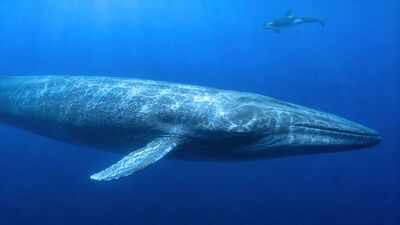
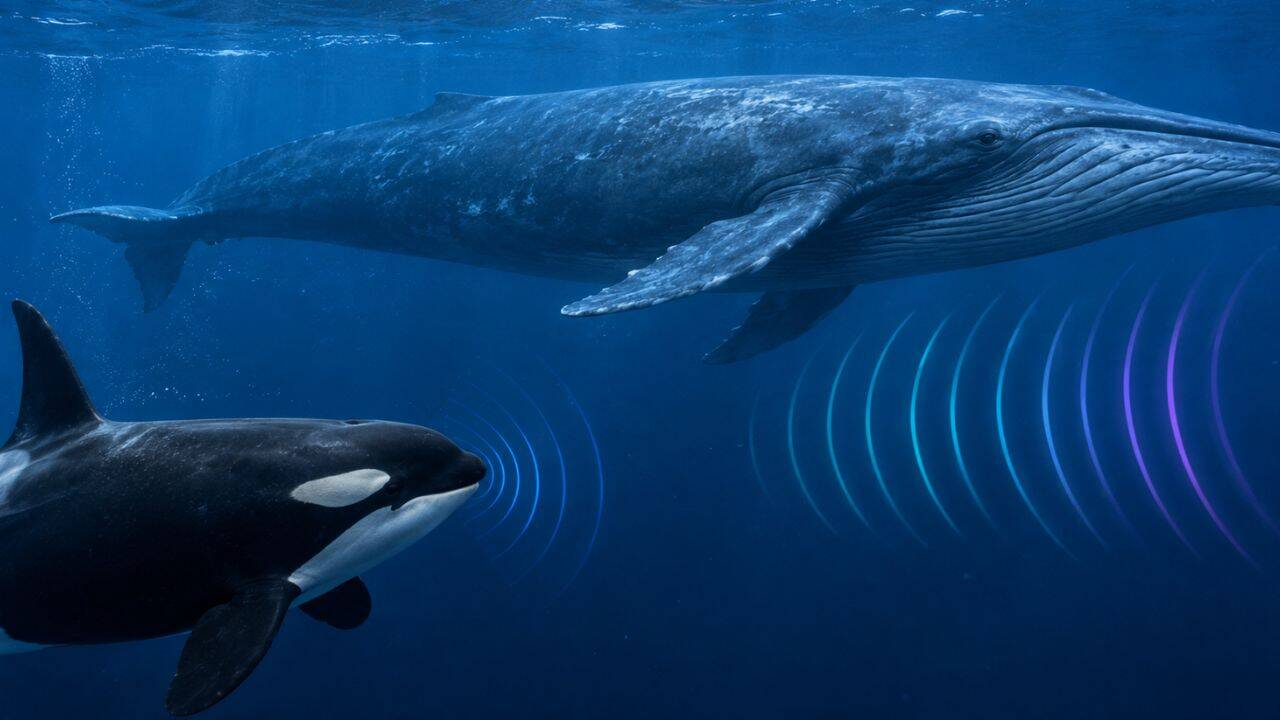
Whales are well known for their songs. But scientists have discovered that, for some whales, those songs may also help them stay alive. A researcher from the University of Washington has found that some baleen whales, including blue, fin and minke whales, have evolved to sing at such low frequencies that killer whales, their only natural predator, cannot hear them.
Scientists addressed this behaviour as acoustic crypsis. It means these whales make themselves difficult for predators to detect by using sounds that killer whales cannot hear. The discovery gives scientists a new understanding of why some whales sing the way they do and shows that the risk of being hunted has influenced how they communicate.
PC: AI Generated
What sound camouflage is and what the study discovered about blue whales
The study, titled “Most 'flight' baleen whale species are acoustically cryptic to killer whales, unlike 'fight' species”, was published in the journal Marine Mammal Science. It was led by Trevor Branch, a professor of aquatic and fishery sciences at the University of Washington.For the study, Branch reviewed aquarium experiments that measured the hearing range of killer whales. He also examined the calls of all baleen whale populations and studied how sound travels through the ocean. This helped him work out which whale calls killer whales are actually able to hear.The results showed that killer whales cannot hear sounds below 100 hertz (Hz). They can only hear loud sounds below 1,500 Hz.
Branch found that the calls of "flight" whale species, which escape when attacked, usually cannot be heard by killer whales from more than one kilometre away.Acoustic crypsis is a behaviour that helps animals avoid being detected by predators. In simple terms, these whales are not singing more quietly. They are singing at frequencies that killer whales cannot hear, making them almost impossible for their predators to detect through sound.
Fight and flight whales use different survival strategies
The study divides baleen whales into two groups: fight species and flight species. Fight species are slower-moving but more manoeuvrable. They protect their calves in winter by gathering in shallow coastal waters and defending themselves if attacked. Flight species are fast swimmers. Instead of fighting, they escape when they detect danger and spend winter spread across deep, open oceans.The flight group includes blue, fin, sei, Bryde's and minke whales.
The fight group includes right, bowhead, grey and humpback whales.The two groups also communicate differently. Fight species produce more complex songs to compete with other whales in a group. Flight species produce loud, simple songs that can travel long distances to attract females.Blue whales are one of the best examples. They are the loudest animals on Earth and can produce calls of around 180 decibels. Even though their calls are extremely loud, they are made at such low frequencies that killer whales cannot hear them.
What this discovery tells scientists
The study also helps explain how these whales evolved. They did not choose to sing at lower frequencies. Over millions of years, natural selection favoured whales whose low-frequency calls were less likely to be heard by killer whales. Those whales were more likely to survive and have young, passing this trait on to future generations.Killer whales live in every ocean and hunt many different kinds of animals, from small fish to the largest whales. For flight species that spend much of their time alone in deep, open waters, staying hidden through sound is an important way of reducing the risk of being attacked. The study shows that the fear of predators has helped shape one of the most advanced communication systems in the animal world.










 English (US) ·