
 2 hours ago
2
2 hours ago
2

A worker at a market for fuel oil and automotive fuel on March 17, 2026 in Erbil, Iraq. Recent drone attacks in the region have forced some oil refineries here to cease operation, while others continue. Sedat Suna/Getty Images Europe hide caption
toggle caption
Sedat Suna/Getty Images Europe
Iran launched new missile attacks on Israel targeting Tel Aviv overnight, after Iran confirmed the deaths of Ali Larijani, who had emerged as a key wartime figure following the killing of Supreme Leader Ayatollah Ali Khamenei, and Gholamrez Soleimani, the head of Iran's Basij paramilitary force. Their deaths were confirmed by Iranian authorities on Tuesday.
Iran's foreign minister. Abbas Araghchi. told Al Jazeera Tuesday the killings would not destabilize Iran's leadership, saying that Iran has "a strong political structure with established political, economic and social institutions."
Israel also struck central Beirut overnight, killing 10 people. Israel's military said it was targeting Hezbollah militants and installations.
Health authorities have reported about 1,300 killed in Iran, 922 in Lebanon and 16 in Israel since the war began on Feb. 28. U.S. Central Command has said 13 U.S. service members have been killed and roughly 200 troops wounded.
Here are the latest updates:
Iran hits back after the killing of two leaders in Tehran
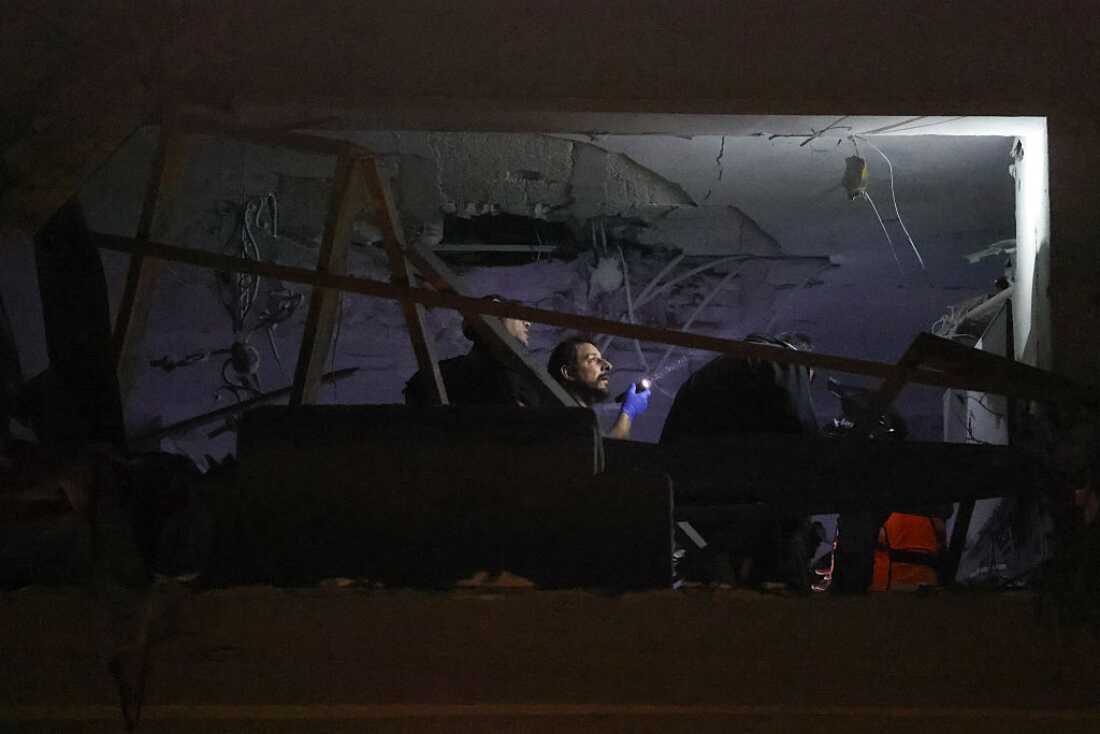
An apartment damaged by a missile strike is seen in Ramat Gan, in the outskirts of Tel Aviv, Israel on March 18, 2026. Ilia Yefimovich/AFP via Getty Images hide caption
toggle caption
Ilia Yefimovich/AFP via Getty Images
Iran's Revolutionary Guard said it targeted the Tel Aviv area Wednesday by firing multiple-warhead missiles, also known as cluster munitions.
A man and woman were killed in their apartment in Ramat Gan, a suburb of Tel Aviv. The Iranian missile attack also caused damage in other parts of central Israel, including a train station in Tel Aviv.
Iran's missile attacks across the region have been the most lethal in Israel, where at least 16 people have been killed since the war started.
Iran said the strikes were "in revenge" for Israel's killing of two top Iranian leaders, Ali Larijani and Gholamrez Soleimani, which were the highest-profile killings in Iran since Israel killed Supreme Leader Ayatollah Ali Khamenei and other top leadership on the first day of the war.
Larijani had a long career in the Iranian political upper echelons, having served as parliament speaker and a top adviser to the assassinated supreme leader. Many believed that after the ayatollah was killed, Larijani would succeed him.
He was also involved in talks with the Trump administration before the war.
"He seemed to be the one person who the international community could talk to and now with him having apparently been killed it's difficult to see how one speaks to in the IRGC," said Zeid Ra'ad Al-Hussein, a former Jordanian ambassador to the U.S. who is president of the International Peace Institute. IRGC are the initials for Iran's powerful paramilitary Revolutionary Guard.
Soleimani led the Basij forces for seven years. They're a volunteer paramilitary militia, a branch of the Revolutionary Guard, which Israel says was responsible for violently suppressing street protests against the Iranian government earlier this year.
— Daniel Estrin
Iran's foreign minister says killings won't destabilize Iran's political system

Rocket trails are seen in the sky amid a fresh barrage of Iranian missile attacks above the Israeli coastal city of Netanya on March 18, 2026. Jack Guez/AFP via Getty Images hide caption
toggle caption
Jack Guez/AFP via Getty Images
In the wake of the killings of the two top leaders, Iranian foreign minister Abbas Araghchi said Iran's government "does not rely on a single individual."
"The presence or absence of a single individual does not affect this structure," Araghchi told Al Jazeera television in an interview.
He added: "Of course, individuals are influential, and each person plays their role – some better, some worse, some less – but what matters is that the political system in Iran is a very solid structure."
— Rebecca Rosman
NPR speaks to Iranians fleeing into Iraq amid fear and a tightening crackdown
Families fleeing Iran from the Haji Omeran border crossing, located between Iran and Iraq, told NPR about what they described as widespread fear of speaking openly, even outside the country.
One woman in her 60s, who requested not to be named because of fear of government reprisal, broke down in tears and said she wished recent airstrikes on her border city had killed her, stating that life had become unbearable between the war and recent security crackdown by Iranian authorities.
Multiple people NPR spoke to described an internet blackout, more checkpoints and Iranian security forces searching through people's phones.
A 40-year-old man, who lives in a city in eastern Iran and asked not to be identified for fear of government reprisal, said he had recently seen security forces move into a mosque and sports stadium, which he said were a sign of heightened security measures.
NPR cannot independently verify these accounts. However, they echo numerous testimonies shared with NPR reporters and those documented by human rights groups with sources in Iran.
— Arezou Rezvani
Israel strikes central Beirut and issues new warning for southern Lebanon
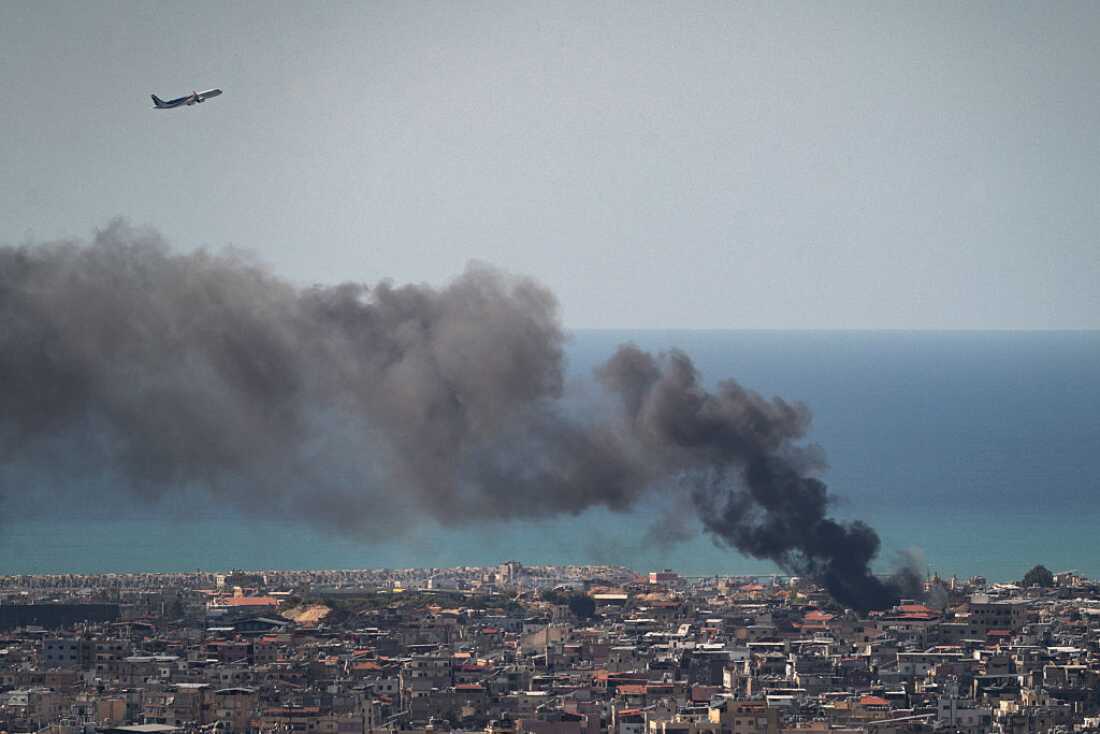
MEA commercial airplane is flying above the smoke after an IDF airstrike on March 17, 2026 in Beirut, Lebanon. Adri Salido/Getty Images Europe hide caption
toggle caption
Adri Salido/Getty Images Europe
Israel struck central Beirut on Wednesday, saying it was targeting Hezbollah militants and installations, as Israel's offensive in Lebanon intensified. Lebanon's health ministry said 10 people were killed in two attacks Wednesday morning.
The Israeli military destroyed a building in the Bachoura neighborhood, which it had previously targeted. Israel had issued an evacuation order for the building on social media at about 4 a.m. local time, and the strikes followed at around 5:30a.m. Bachoura is a residential and commercial district near the Lebanese prime minister's office and several foreign embassies in Beirut.
The strikes came as Israel issued new evacuation orders for parts of southern Lebanon. Lebanon's health ministry also condemned Israeli strikes that it said damaged three public hospitals in Nabatieh, a major city in the country's south.
— Hadeel Al-Shalchi
Daniel Estrin contributed to this report from Tel Aviv, Israel, Hadeel Al-Shalchi from Beirut, Arezou Rezvani from Irbil, in Iraq's Kurdish region and Rebecca Rosman from Paris.







 English (US) ·