
 7 hours ago
4
7 hours ago
4
Eve WebsterBBC News
 Getty Images
For 21-year-old John Alexander, being against abortion came before finding faith.
As a teenager at school in Buckinghamshire, he was confused as to why most of his peers supported access to abortion. On social media he argued vocally against it.
Then, shortly after the pandemic, he became more interested in Christianity. He was raised in the Church of England (CofE), but thought the denomination was "dry" and involved "people sitting in pews not doing much". He was inspired by the young pastor at a Pentecostal Church which discussed social issues like abortion more than CofE churches, he says. He also watched social media videos of street preachers.
At university he joined the pro-life society and later he became a fan of the American right-wing commentator Charlie Kirk.
"In the UK, people want to be polite, so they don't tackle abortion in the same way because they are scared to talk about it," he says. "For those who are frustrated by the culture here, they look at the States and how vocal people are, and [they] are inspired."
Last month, John attended the Society for the Protection of Unborn Children's Youth Conference - where attendance has grown steadily every year since it was created, organisers say.
 Getty
Getty
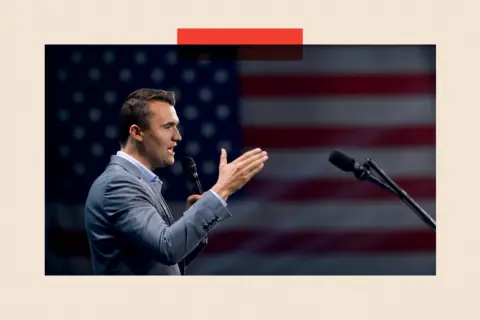
Charlie Kirk, who had ties to the White House, toured universities in the US and other countries preaching anti-abortion politics
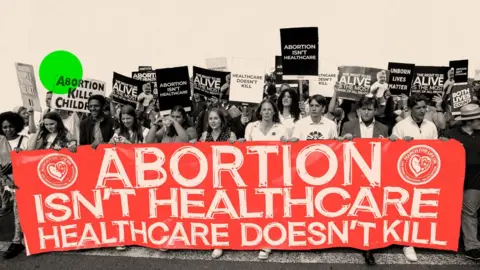
Analysts, charity leaders, and young anti-abortion activists who have spoken to the BBC say they have spotted a rise in the number of British young people embracing anti-abortion activism.
There's no single, clear cause.
The BBC has heard explanations that include opposition to the Crime and Policing Bill, which is currently working its way through Parliament and which will decriminalise abortion at every stage of pregnancy in England and Wales (meaning women will not be prosecuted for ending their own pregnancies, even if they do it late in term, though doctors will still be bound by the existing 24-week limit).
And some anti-abortion campaigners cite an increase in young people like John discovering (or rediscovering) Christianity, particularly Catholicism (though this trend is contested).
But there's another factor that has become particularly notable in recent months: the influence of America. Some young British people have told the BBC that they have been galvanised by US anti-abortion groups, many of which now have branches in Britain. And Charlie Kirk - the late political activist who toured US college campuses preaching right-wing views - has become something of a hero among a small group of young British people online.
Why are US anti-abortion groups and individuals becoming more prominent in Britain - and could their brand of politics actually succeed in a country with such a different political culture?
Those who support abortion rights say the nature of anti-abortion campaigning in Britain has changed.
Rachael Clarke, chief of staff at the British Pregnancy Advisory Service (BPAS), the country's largest abortion provider, is one of them.
"Up until the 2000s you would see maybe a nun or a priest quietly outside the clinic, but since about 2013 we were seeing groups like 40 Days for Life protesting," she says.
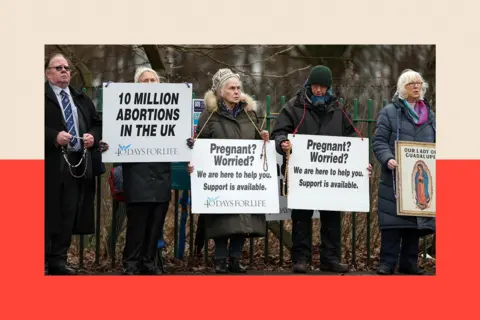
Created in Texas in 2004, 40 Days for Life is one of several American anti-abortion groups which now has a growing presence in the UK. It supports protesters to work in shifts outside abortion clinics for 40 days over Lent, and another 40 days in the autumn.
Clarke says that some British young people have become more interested in anti-abortion ideas, a trend she attributes in part to the likes of 40 Days For Life and other American groups, who she says were galvanised by the US Supreme Court's overturning of Roe v Wade in 2022.
 Getty
Getty
Protesters from 40 Days For Life demonstrate near a Glasgow hospital in 2025
"I think they've been looking about how to expand overseas. And because it's a common language, [the] UK is an easier place to start to echo what they've done in the US in terms of influence and spending."
Particularly significant is Turning Point USA, a non-profit organisation that advocates for conservative politics in schools, colleges and universities, founded in 2012 by Charlie Kirk, who enjoyed close ties to the White House, particularly Vice President JD Vance. Kirk was passionately against abortion; he called it a "massacre" that is "worse" than the Holocaust.
In 2018, the group launched a branch in the UK (called Turning Point UK).
John was a particular fan of Kirk. "His videos are kind of hard to escape," he says.
The killing of Kirk at Utah Valley University last year, left a deep impression on John. "Charlie died for standing on the truth of Jesus Christ, and his death should send other Christians a message and should convict us," he said in his TikTok video titled "Charlie Kirk was a Christian Martyr", which has almost 35,000 views.
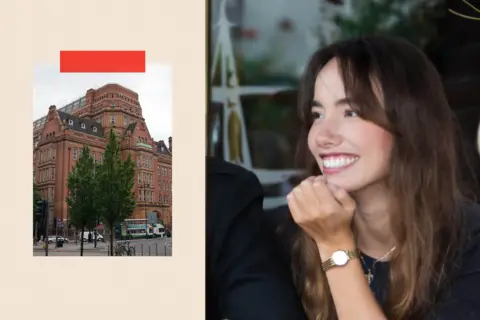 Getty / Inge-Maria Botha
Inge-Maria Botha, a student at the University of Manchester, was recognised for her anti-abortion activism with an award named after the late American right-wing commentator Charlie Kirk
Inspired by Kirk's activism, John has since made more of his own social media videos. One of them, called "Britons go to Church", has more than 24,000 views. He also has established a charter of Turning Point UK in Oxford.
Meanwhile, in October last year, on the day that would have been Kirk's 32nd birthday, a coalition of ten UK anti-abortion groups established the Charlie Kirk Young Pro-lifer prize. The inaugural winner was Inge-Maria Botha, 22, an undergraduate at the University of Manchester. Her feelings towards Kirk are more nuanced than straight fandom.
"The award isn't about perfect alignment on every belief with Charlie Kirk, but about courage and action," she says. "He was proactive, and unashamed in standing for life. This is why it's deeply meaningful to receive an award that is named after a man who was purposeful in being pro-life."
Botha claims that a growing number of her peers are interested in the anti-abortion movement. She says many are motivated by discovering, or (in her case) rediscovering Christianity, particularly Catholicism. She recently set up a new pro-life society at Manchester University, amid opposition from other students.
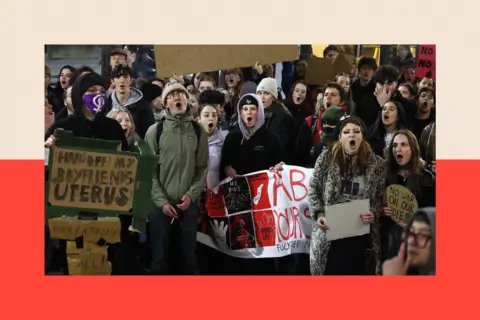 Sean Hansford/Manchester Evening News
Some students protested against the new anti-abortion society at the University of Manchester in March 2024
Hundreds protested outside the group's inaugural meeting and a petition calling for the society to disband reached over 18,000 signatures. Videos show police escorting members of the society out of meetings.
And then there's the money.
Amnesty International UK - a human rights-focused, pro-choice charity - has observed a significant increase in spending on the anti-abortion cause in Britain. They analysed the expenditure of 25 anti-abortion groups and six UK branches of socially conservative US organisations. Between 2020 and 2023, they say, the expenditure of anti-abortion groups increased by 34%, and British branches of US organisations by 46%.
Rachel's Vineyard, a charity which offers retreats for people who feel negatively affected by an abortion (be it their own or someone else's) registered in the UK in 2020. It is heavily inspired by an American charity of the same name created in the 1990s. In its first year, Rachel's Vineyard UK spent just under £12,000. In the financial year ending March 2025 it spent £77,662.
It told the BBC that "Rachel's Vineyard UK is funded entirely through charitable giving within the UK and does not receive financial support from abroad".
This is not true for all groups.
The Alliance for Defending Freedom (ADF), founded in Arizona in the 1990s, claims to have played a role in overturning Roe v Wade. In 2015, an organisation with a similar name - ADF International (UK) - was founded in London. The majority of funding for the UK-based organisation comes from the US-headquartered ADF.
In 2020, the UK-based organisation received £324,000 in support from ADF in the US. By 2024 that had risen to £1.1m, out of a total £1.3m income, according to its 2024 annual report. Over the same period, it increased its number of staff from three to nine.
An ADF UK spokesperson told the BBC that their "work is privately funded, and we fully comply with all rules set out by the various regulators of the countries we are based in, including the UK."
Of course, pro-choice groups also spend money. BPAS spent roughly £1.2m on "education, advocacy and research" in the last financial year, whilst charities like Amnesty have also spent funds campaigning for "reproductive rights" in the UK.
Some American anti-abortion groups are particularly aggrieved by Britain's new system of "buffer zones" outside abortion clinics.
In 2023, the Public Order Act made it illegal in England and Wales to intentionally or recklessly influence someone's decision to use abortion services. In practice, that means it is now illegal to protest against abortion within 150 metres of a clinic. A similar law was created in Scotland in 2024.
In his bombshell speech at the Munich Security Conference in 2025, Vance criticised this law. He said the ban "placed the basic liberties of religious Britons… in the crosshairs". He also drew attention to the conviction of ADF UK client Adam Smith-Connor, who was found guilty in 2022 of breaching a Public Spaces Protection Order by praying outside an abortion clinic in Bournemouth and refusing requests to move on.
ADF UK has provided legal support to four anti-abortion protesters who have been charged with encroaching on so-called buffer zones. Alongside providing legal assistance, ADF UK told the BBC that they arranged for their clients to meet officials from the US State Department.
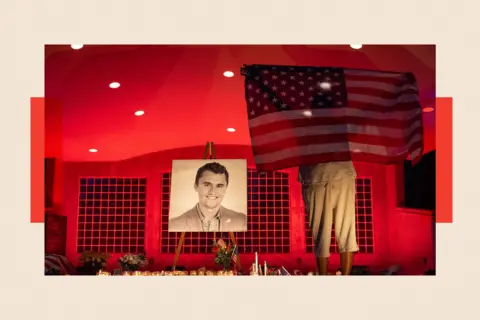 Getty
Getty
Following his death, Charlie Kirk has become something of a hero among a small group of British young people online
Professor Fiona De Londras, a specialist in abortion law at the University of Birmingham, believes that in challenging the legalities of buffer zones, ADF UK is "using these apparently neutral argumentative frameworks, like freedom of speech, to make fundamentally religiously motivated arguments."
But success in defending clients in court has been limited. Of their two named clients who have faced trial, both have lost. Their client Livia Tossici-Bolt was convicted of breaching a buffer-zone in Bournemouth last April. Adam Smith-Connor, whose case was highlighted by Vance, was similarly convicted in October 2024. Tossici-Bolt was given a two-year conditional discharge and ordered to pay £20,000, while Smith-Connor was handed a two-year conditional discharge and ordered to pay more than £9,000 in costs.
De Londras believes there is a fundamental mismatch between how the US and UK frames freedom of speech. "In the US, the right to freedom of speech is a very, very broad right. In the UK and the EU, it is still a right, of course, but it can be limited by reference to the rights of others," she says.
"This has been so far why ADF's clients are not winning their cases under British law."
But she believes that success in court is not ADF's only aim. "Their strategy didn't work in the US for decades, but legal experimentation - taking on different cases and seeing how they work out - is a hallmark of how they work. After 50 years they were able to help overturn universal access to abortion in the US. These are people who play a long game."
ADF told the BBC it is "completely false" to say they "instrumentalise free speech for other aims". A spokesman said: "We are both pro-life and pro-free speech, as we believe both of these human rights flow from the inherent dignity of each human."
They also denied that any of their clients sought to engage in "legal experimentation".
But even with the new energy from young people and increased American funding, there are serious impediments to a US-style anti-abortion movement taking root in Britain.
A report in 2024 from the National Centre for Social Research, a UK charity, compared abortion attitudes in Britain in the US. It found that 86% of British adults think that abortion should be legal in "all" or "most" cases, versus 63% in the US.
That said, support varies across different groups. A different survey from Ipsos last year found that less than half (46%) of British men aged 16-34 agree that abortion should be legal in all or most cases.
John, the young man from Buckinghamshire, says he is "increasingly seeing religious arguments land with young people – more so than they probably would have five or six years ago".
For now at least, there is broadly a pro-choice consensus in British politics - another sharp difference to the US. None of the parties that won seats in England, Scotland, or Wales at the last election promised to restrict abortion in their manifesto. And in June last year MPs voted to decriminalise abortion, with a majority of 242. It was the biggest shake-up to the law since 1967, when Parliament voted to legalise abortion for the first time, setting a 28 week limit (reduced to 24 weeks in 1990).
"Although some of the movement can transfer over and you certainly see some influence, we are actually a very fundamentally different society in the UK," Clarke from BPAS argues.
"Look at the number of Americans who attend church on a weekly basis. Look at the number of Americans that believe in angels. These are a very different group of people to the UK as a whole."
As director of March for Life UK, Isabel Vaughan-Spruce helps to organise an annual march through London to protest abortion. The group's website states that its founders were inspired by March for Life America.
But speaking to the BBC, Vaughan-Spruce was reticent to say that Britain's abortion debate is being influenced by America.
"We have a gentler approach here, and the UK's anti-abortion movement is older than the US's," she says.
Vaughan-Spruce is one of the defendants receiving legal assistance from ADF UK. She is accused of silently praying outside an abortion clinic in Birmingham last year. She faces trial in October for a public order offence, which she denies.
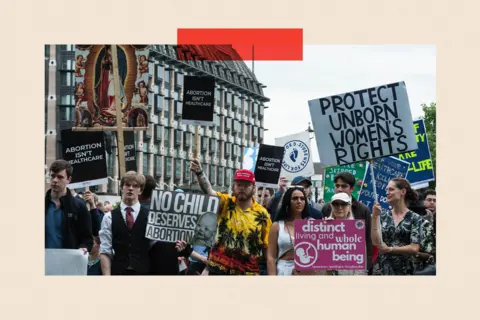 Getty
Getty
Anti-abortion protesters gather near Parliament in September 2024
Fresh from a visit speaking to Oxford University students, she is currently arranging a Lent fundraiser.
"When I think about the future, I'm encouraged more young people are joining and how they grasp the issue," she says. "A lot of them want to get involved. When we first started March for Life in 2012, being really honest, we'd get younger people to come to the front for the photographs, because it looked better.
"Now, they're just everywhere."
These young people remain a minority in the UK. But with Britain's anti-abortion movement enjoying fresh blood and funding, Britain's broadly pro-choice consensus is not guaranteed to last.

BBC InDepth is the home on the website and app for the best analysis, with fresh perspectives that challenge assumptions and deep reporting on the biggest issues of the day. Emma Barnett and John Simpson bring their pick of the most thought-provoking deep reads and analysis, every Saturday. Sign up for the newsletter here






 English (US) ·