
 1 hour ago
4
1 hour ago
4
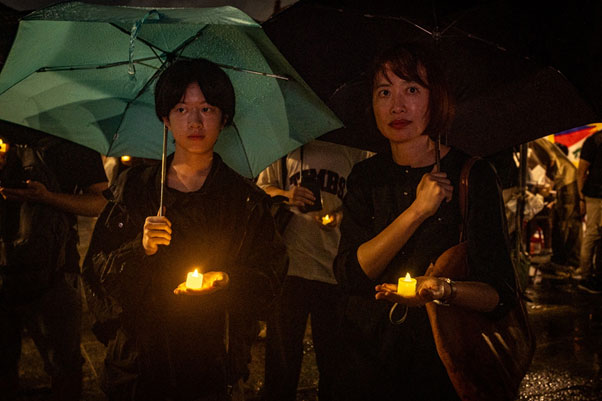 People hold electronic candles during a vigil at Liberty Square in Taipei on the anniversary of China’s 1989 crackdown on democracy protesters in Beijing's Tiananmen Square, 4 June 2026. Credit: Cheng-Chia Huang/AFP
LONDON, June 19 (IPS) - When performance artist Sammu Chen tried to tie a red thread to a streetpost, plainclothes police stopped him before he could finish. Chen has twice been detained for his symbolic acts of commemoration of the 4 June 1989 Tiananmen Square Massacre, when Chinese authorities killed hundreds, perhaps thousands, to crush democracy protests.
The day used to one of commemoration in Hong Kong. Tens of thousands used to attend the mass vigil. But authorities banned it during the COVID-19 pandemic and haven’t permitted it since.
Chen’s attempted act of commemoration took place near the former site of the banned vigil. Close by, police moved on another artist marking the anniversary by holding a question mark-shaped balloon. In recent years, other symbolic acts, such as silently holding candles or flowers, have led to arrests. The organisation that used to hold the vigil closed itself down in 2021 following police investigations and prosecution of its leaders.
China’s campaign to stamp out demands for democracy in Hong Kong doesn’t stop at its borders, as events in the UK recently made plain.
UK spy network
Last month, two men with dual British and Chinese nationality were found guilty of spying on Hong Kong democracy activists in the UK. The case showed how far the Chinese state is prepared to go to silence Hong Kong’s diaspora.
Chi Leung Wai, who worked for the UK’s Border Force, and Chung Biu Yuen, who worked for the Hong Kong Economic Trade Office in London, were found to have carried out shadow policing operations to gather information on exiles. The spies also targeted UK politicians critical of China.
One of their targets was Nathan Law. Law was a student leader and politician active in Hong Kong’s democracy movement, which mobilised in mass protests in 2014 and again in 2019. Having spent time in jail in 2017 for his role in protests, he headed into exile in 2020 when the authorities introduced a draconian National Security Law.
In 2023, Law was one of eight activists the Hong Kong police targeted with arrest warrants, with a bounty of around US$130,000 offered as a reward. Hong Kong police took Law’s parents and brother in for questioning, and in 2024, authorities revoked his passport and those of other exiled activists.
Escalating transnational repression
Such is the level of repression China exerts in Hong Kong that activism can only be sustained among the diaspora. But while many states are exerting transnational repression against diasporas and exiles, the spy case shows that China remains the world leader in this field.
Hong Kong police issued a further round of arrest warrants and bounties against six more exiled activists in December 2024 and announced bounties on another 19 in July 2025. Hong Kong authorities have also started targeting exiles with spurious tax demands and may be gearing up to weaponise international anti-money laundering cooperation agreements against them.
Exiles’ families in Hong Kong aren’t spared. In February, Kwok Yin-sang, father of exiled activist Anna Kwok, was handed an eight-month sentence for violating national security laws after he tried to cash in her education savings insurance policy.
Around 100,000 people have fled Hong Kong to the UK, which controlled the territory before handing it over to China in 1997. That makes them a particular target. In 2024, addresses of Hong Kong citizens living in the UK were published online and anti-migrant protesters were encouraged to attack them, in a move that showed all the signs of a Chinese influence operation.
Intensifying domestic repression
As a new CIVICUS report documents, repression has intensified further within Hong Kong. In 2024, authorities introduced the Safeguarding National Security Ordinance, which allows them to criminalise simple acts of dissent by claiming they constitute secession, sedition, subversion and other major crimes. They’ve used this latest law’s sweeping provisions and the 2020 National Security Law to prosecute activists, dissidents and journalists. Since 2020, Hong Kong authorities have arrested at least 365 people and convicted 174 under the two laws. People have been convicted for such trivial offences as wearing T-shirts with protest slogans.
The authorities’ determination to silence dissent was on display again in the aftermath of a horrendous apartment complex fire in November 2025, in which over 160 people died. People were arrested for social media posts calling for accountability . Student Miles Kwan Ching-fung was detained and expelled from university after starting an online petition urging an independent investigation. China’s national security office in Hong Kong warned foreign journalists about negative coverage of the government’s response.
Hong Kong once had one of Asia’s most vibrant media environments, but now it ranks 140th out of 180 on the Reporters Without Borders World Press Freedom Index. In February, media owner Jimmy Lai, whose Apple Daily newspaper championed democracy, received a 20-year sentence under the National Security Law. Lai has been detained under multiple charges since 2019, often in solitary confinement. At 78 years old with diabetes and other reported health problems, he faces dying in jail. Despite Lai’s British citizenship, China has refused international appeals for his release.
The campaign against Lai continues, with four bookshop staff arrested in March on suspicion of selling copies of his biography, deemed a seditious publication. The authorities’ attempts to suppress the book are part of their wider cultural censorship, which extends to banning films, barring publishers from book fairs and demanding the blocking of YouTube videos of the protest anthem ‘Glory to Hong Kong’. In the face of this repression, many civil society organisations, media outlets and political parties have concluded that their only option is to close down.
In these circumstances, it will continue to fall on the diaspora to keep shining a light on the suppression of basic civic freedoms in Hong Kong. States where Hong Kong’s exiles live must be alert to the threats of China’s transnational repression and defend and protect exiled activists. They must confront the full scope of this repression, or be complicit in it.
Andrew Firmin is CIVICUS Editor-in-Chief, co-director and writer for CIVICUS Lens and co-author of the State of Civil Society Report.
For interviews or more information, please contact [email protected]
© Inter Press Service (20260619170845) — All Rights Reserved. Original source: Inter Press Service








 English (US) ·