
 1 month ago
66
1 month ago
66
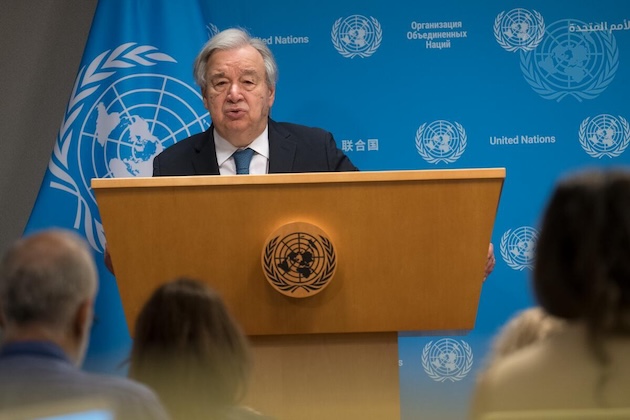 UN Secretary-General António Guterres at the launch of the preliminary report from the UN Independent Panel on AI. Credit: UN Photo/Mark Garten
UNITED NATIONS, July 16 (IPS) - As the international community continues to weigh the good, the bad and the deadly in artificial intelligence (AI), which is spreading far and wide with apparently no guardrails, the United Nations is taking a closer look at the impact, both positive and negative, of AI.
UN Secretary General Antonio Guterres said last week that “the technology is heightening the danger, with sophisticated and increasingly autonomous new weaponry, including drones, able to inflict massive harm on populations.”
The new weapons, particularly Unmanned Aerial Vehicles (UAVs), more commonly known as drones, seem to be a new wave of killing machines in recent conflicts, including the US vs. Iran, Israel vs. Palestine and Lebanon, and Russia vs. Israel, plus scores of civil wars in Africa and Asia.
Simon Adams, Professor of Human Rights at Murdoch University in Australia and former President and CEO of the Center for Victims of Torture—a leading international human rights and humanitarian NGO—told Inter Press Service no country in the world has openly admitted to deploying a weapon that is completely autonomous in the sense of killing humans without a person also being involved in the decision-making process.
“But there are already a number of powerful states—including several that sit around the table at the UN Security Council—who are increasingly dependent on drones, robots and AI systems to fight wars for them. Algorithms are choosing bombing targets and are already responsible for killing civilians in some major conflict zones.”
AI has the potential to improve the lives of billions of people on this planet. It would be a moral failing of epic proportions and a global tragedy if AI were harnessed to innovate new ways for humans to outsource the dirty work of waging war to robots, he said.
“Killer robots are a horror that belongs in science fiction. There is nothing more sinister than outsourcing killing and warfighting to emotionless, faceless machines that will select which humans get to live or die. Lethal autonomous weapons systems are ethically indefensible and should be illegal. We need a global ban before it is too late.”
Guterres has also reiterated his call to have them banned by international law, adding that some decisions must remain forever human, none more than taking a human life.
David Swanson, campaign coordinator for RootsAction, told IPS dozens of national governments have already stated their support for banning autonomous weapons, and dozens of others expressed their inclination to support such a ban.
So, a treaty could be established among those nations, on the model of the recent Treaty on the Prohibition of Nuclear Weapons (TPNW) and then work could be done to add more nations to it. The initial signers and ratifiers would be the small and medium nations with the most willingness to defy the will of the U.S. government.
This banning of a particular type of weapon would ignore, as does the TPNW, the existence of the Treaty on the Nonproliferation of Nuclear Weapons, which requires disarmament of all weapons. It would also fail to address the morally repugnant act of ordering a young person, on pain of severe punishment, to press a button that sends a missile into people thousands of miles away—an act of dubious moral superiority to setting loose fully autonomous killer robots, he declared.
“But the biggest denier of reality in all of this is the U.S. government, which pioneered drone wars, was widely warned that it would not like the results when other nations followed suit, went on to suffer huge damage from foreign drones in places like the Persian Gulf during the current war on Iran, and altered its agenda not one iota. As guns sometimes appear to have more rights within the United States than children do, all forms of weaponry seem to be treated as deserving first consideration in U.S. foreign policy’,” he said
According to the New York Times of July 13, for decades Western governments have ordered supplies like tanks, fighter jets and submarines from contractors such as Lockheed Martin or Northrop Grumman—items that take years to deliver and are dizzyingly expensive: an F-35 jet can run to over $100 million.
“But the current trend is clear: defense technology is becoming cheaper and nimbler, with breakthroughs developed by privately funded companies rather than governments,” says an article authored by Vivienne Walt.
Of the Pentagon’s $1.5 trillion budget request by the current US administration for next year, about $55 billion is earmarked for the creation of a new unmanned, AI-powered arsenal.
Singling out a more positive non-military use of drones, the Times said last month that Sri Lanka, faced with one of the worst outbreaks of dengue fever in years, is using military drones to scan rooftops and find mosquito breeding grounds to eliminate them. The country’s air force has been routinely flying drones over high-rise buildings to identify breeding sites.
Nick Mottern, co-coordinator of the Weaponized Drone Ban Treaty Campaign, told IPS: “We are calling for a treaty to remove all weapons from drones, rather than to ban drones controlled autonomously by AI.
This is because all militaries will claim that there will always be a human in ultimate control of AI-augmented drones in spite of the fact that the drone will identify targets using AI, select weapons using AI, and present a human with all elements of the decision to kill using AI.
A treaty banning weapons on drones is the only way to stop the drone tsunami, he declared
Speaking at the First Global Dialogue on AI Governance in early July, Guterres said the world faced more than 120 conflicts in 2025.
Conflicts are becoming more protracted, more complex, and more interconnected, he pointed out. “We see widespread violations of international law and a growing sense of impunity. Technology is heightening the danger, with sophisticated — and increasingly autonomous — new weaponry, including drones, able to inflict massive harm on populations.”
“And online hate speech, misinformation and disinformation are spread and amplified in an instant. Too often, early warning signs are ignored. And responses are often a little too late.”
IPS UN Bureau Report
© Inter Press Service (20260716081826) — All Rights Reserved. Original source: Inter Press Service






 English (US) ·