
Iranian strikes hit two communities near Israel's main nuclear research center, leaving at least 90 people injured in the southern part of the country. It was the first time Israel's nuclear research center has been targeted in the war that began three weeks ago.
The strikes came hours after Iran's Natanz nuclear enrichment facility was hit in an airstrike, for which Israel's military has denied responsibility.
Israel's military said it was not able to intercept the Iranian missiles that hit the cities of Dimona and Arad, the largest near the center of Israel's sparsely populated Negev desert.
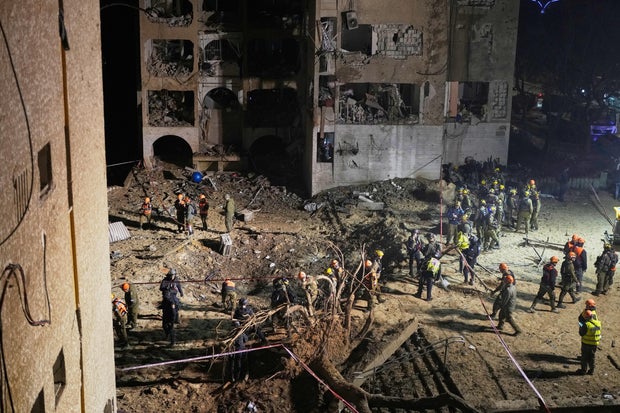 Israeli security forces and rescue teams work at the site struck by an Iranian missile in Arad, southern Israel, Sunday, March 22, 2026.
Ohad Zwigenberg / AP
Israeli security forces and rescue teams work at the site struck by an Iranian missile in Arad, southern Israel, Sunday, March 22, 2026.
Ohad Zwigenberg / AP
Israel's Magen David Adom emergency rescue agency said early Sunday morning that at least 59 people were injured in the strike on Arad. A Magen David Adom spokesperson said that six were hospitalized in serious condition, 13 in moderate condition and 40 in mild condition.
Magen David Adom teams are continuing to search the debris for more casualties, the agency said.
In a separate Iranian strike hours earlier on the nearby town of Dimona, at least 33 people were injured, Magen David Adom previously reported.
Following the two strikes, Israeli Prime Minister Benjamin Netanyahu vowed that Israel's military would continue in its war efforts in the Middle East.
"This is a very difficult evening in the campaign for our future," Netanyahu said in a statement posted to social media, adding that he had spoken to the mayor of Arad, one of the two towns that was struck, and conveyed "our prayers for the peace of the injured."
"We are determined to continue to strike our enemies on all fronts," Netanyahu wrote.
"It is becoming increasingly clear that the Iranian regime is resorting to reckless attacks that only further expose its instability and disregard for human life while strategically targeting civilians, said Lt. Col. Nadav Shosh, an Israel Defense Forces spokesperson, on social media.
Footage from Israel's emergency service showed a large crater next to what appeared to be apartment buildings with outer walls sheared away. The missile appeared to have struck an open area.
Rescue workers said the direct hit in Arad caused widespread damage across at least 10 apartment buildings, three of them badly damaged and in danger of collapsing.
Israel is believed to be the only Middle East nation with nuclear weapons, though its leaders refuse to confirm or deny their existence. The International Atomic Energy Agency, the United Nations' nuclear watchdog, said on X it had not received reports of damage to the Israeli center or abnormal radiation levels.
Israel Saturday denied responsibility for the strike on Iran's Natanz nuclear facility, located about 135 miles southeast of Tehran. The Iranian judiciary's official news agency, Mizan, said there was no leakage. The IAEA said on X it was looking into the strike, but that "no increase in off-site radiation levels" had been reported.
The nuclear facility had already been struck by Israeli airstrikes during the Iran-Israel 12-day war in June 2025, and later that month by the U.S.
The IAEA has said the bulk of Iran's estimated 970 pounds of enriched uranium is elsewhere, beneath the rubble at its Isfahan facility, which was also bombed by the U.S. last June.
The Pentagon declined to comment on the strike on Natanz, which was also hit in the first week of the war and in the 12-day war last June.
"If the Israeli regime is unable to intercept missiles in the heavily protected Dimona area, it is, operationally, a sign of entering a new phase of the battle," Iran's Parliament Speaker Mohammad Bagher Ghalibaf said on X before word of the Arad strike spread.
On Friday, multiple people briefed on the discussions told CBS News that the Trump administration has been strategizing methods and options to secure or extract Iran's nuclear materials. The timing of any such an operation, if President Trump were to order it, remained unclear. One source said he has made no decision yet.
In:
Latest on U.S. involvement in Middle East
Trump signals possible "winding down" in Iran as Marines head to Middle East
(04:19)








 English (US) ·